Unveiling the gas phase H₂NCO radical: Laboratory rotational spectroscopy and interstellar searches in the direction of IRAS 16293-2422

Marie-Aline Martin-Drumel, Audrey Coutens, Jean-Christophe Loison, Jes K. Jørgensen, Olivier Pirali
Astronomy & Astrophysics
687,
A233
(2024)
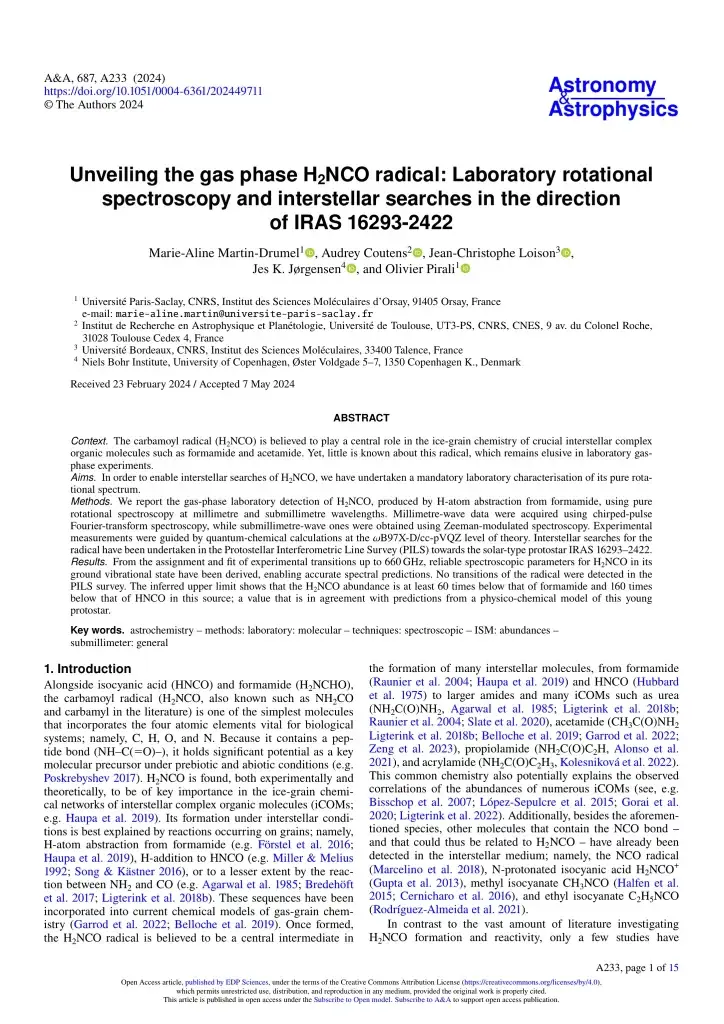
First page of Martin-Drumel et al. 2024, Astronomy & Astrophysics
Martin-Drumel et al. (2024)
Astronomy & Astrophysics 687, A233

Research overview

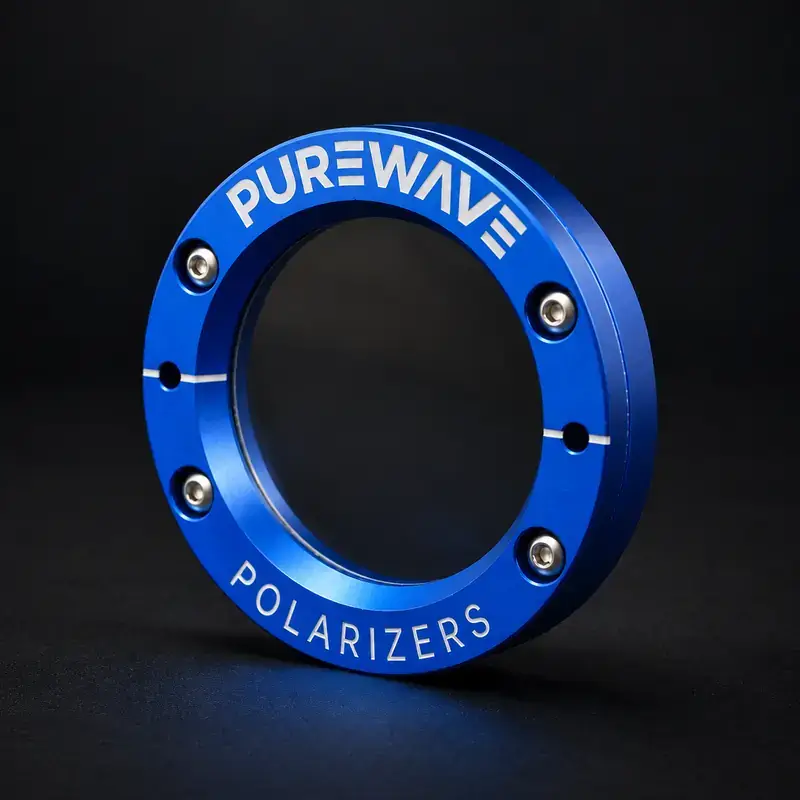
Researchers at the Institut des Sciences Moléculaires d’Orsay and partner institutions in Toulouse, Bordeaux and Copenhagen made the first gas-phase laboratory detection of the carbamoyl radical (H₂NCO). This radical is thought to be central to the ice-grain chemistry that forms formamide, acetamide and other interstellar complex organic molecules. They produced it by H-atom abstraction from formamide. Its pure rotational spectrum was recorded up to 660 GHz, with chirped-pulse Fourier-transform spectroscopy at millimetre wavelengths and Zeeman-modulated spectroscopy at submillimetre wavelengths. The resulting spectroscopic parameters were used to search ALMA survey data of the young solar-type protostar IRAS 16293-2422, where the radical was not detected. A Purewave wire-grid polarizer placed after the radiation source improved the submillimetre line profiles.

Key findings

  • H₂NCO was detected in the gas phase in the laboratory for the first time, produced by H-atom abstraction from formamide.
  • Transitions up to 660 GHz were assigned and fitted, giving reliable spectroscopic parameters for the ground vibrational state.
  • Placing a polarizing grid right after the source filtered out non-vertically polarized radiation and reduced the asymmetric line profiles caused by the magnetic field.
  • H₂NCO was not detected towards IRAS 16293-2422. Its abundance is at least 60 times below formamide and 160 times below HNCO, consistent with chemical models.
Martin-Drumel et al.,
2024

Publication details

Journal

Astronomy & Astrophysics

Volume

687

Issue

Article

A233

Published

2024

Research area

Spectroscopy and Molecular Physics

Application

Laboratory rotational spectroscopy of an interstellar radical

Institution

Université Paris-Saclay, CNRS, Institut des Sciences Moléculaires d’Orsay