Laboratory Detection of the Methoxymethyl Radical, CH₃OCH₂, Using Faraday Rotation and Chirped-pulse Techniques in the (Sub)millimeter Wave Range

Rosemonde Chahbazian, Marie-Aline Martin-Drumel, Olivier Pirali
The Astrophysical Journal
982,
162
(2025)
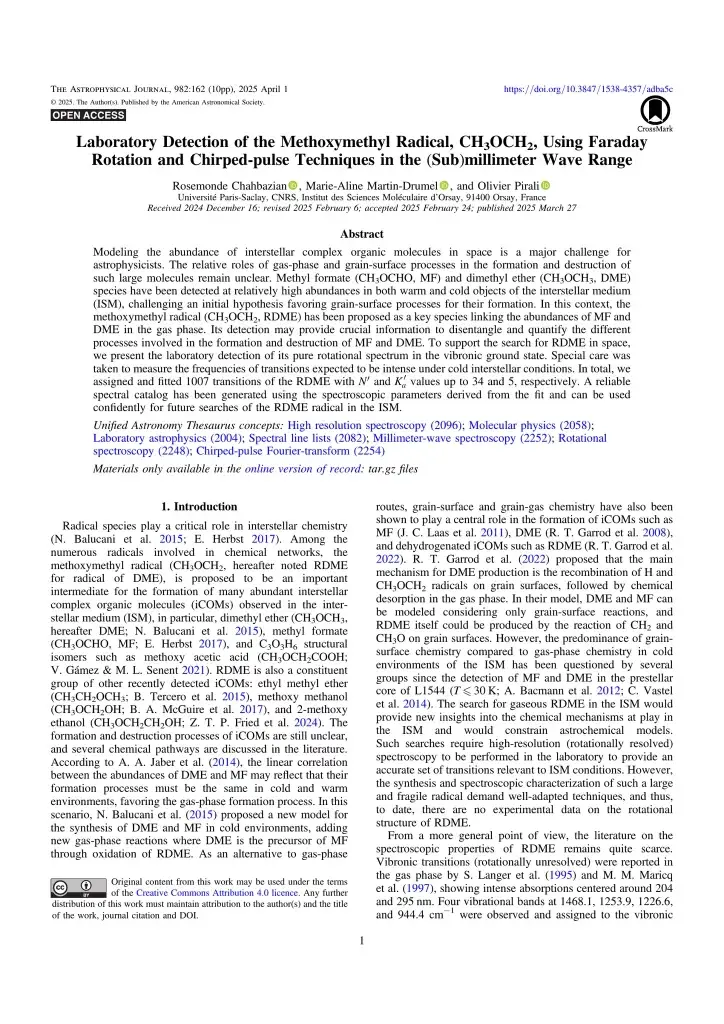
First page of Chahbazian et al. 2025, The Astrophysical Journal
Chahbazian et al. (2025)
The Astrophysical Journal 982, 162

Research overview

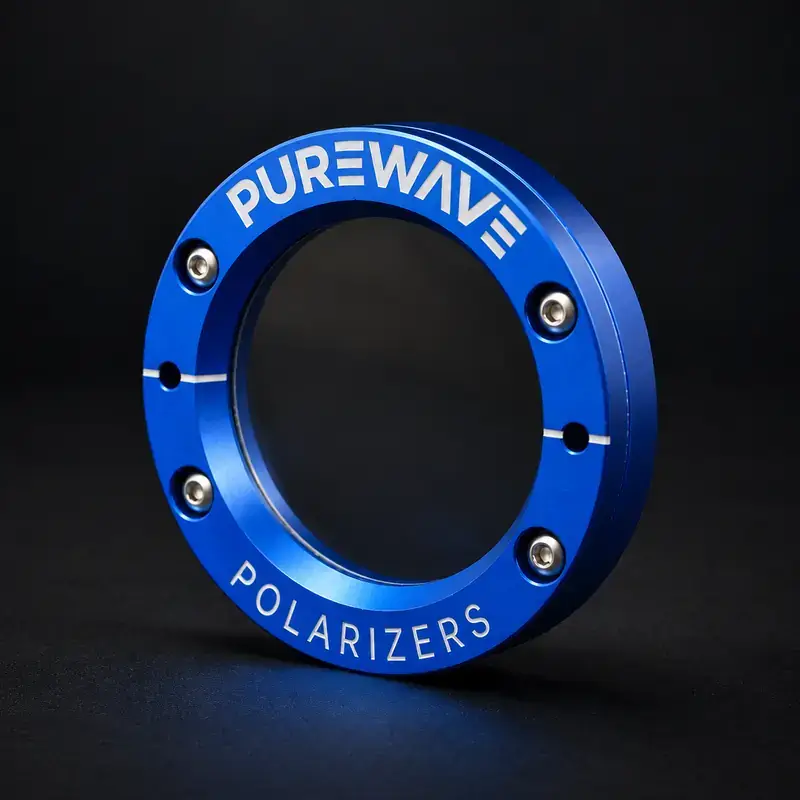
Researchers at the Institut des Sciences Moléculaires d’Orsay recorded the first laboratory rotational spectrum of the methoxymethyl radical (CH₃OCH₂). This radical is thought to link methyl formate and dimethyl ether in interstellar gas-phase chemistry. They made it by fluorine-atom H-abstraction from dimethyl ether and measured it from 140 to 650 GHz, using Faraday-rotation spectroscopy alongside chirped-pulse techniques. Faraday rotation detects only magnetic (paramagnetic) species, which filters out most lines from the precursor. In total, 1007 transitions were assigned and fitted. The result is a reliable catalogue for radio-astronomical searches. Two wire-grid polarizers set the polarization at the cell entrance and analyse it at the cell output.

Key findings

  • The first laboratory detection of the rotational spectrum of the methoxymethyl radical (CH₃OCH₂), a proposed link between methyl formate and dimethyl ether in the interstellar medium.
  • 1007 transitions were assigned and fitted, with N up to 34 and Ka up to 5, giving a reliable catalogue for searches in space.
  • Faraday-rotation spectroscopy from 140 to 650 GHz filtered out most lines from the dimethyl ether precursor and separated the spin–rotation components by their phase.
  • A polarizing grid at the cell entrance cleaned the input polarization, and a second grid at 45° at the output turned the polarization rotation into a measurable amplitude signal.
Chahbazian et al.,
2025

Publication details

Journal

The Astrophysical Journal

Volume

982

Issue

Article

162

Published

2025

Research area

Spectroscopy and Molecular Physics

Application

Faraday-rotation rotational spectroscopy of an interstellar radical

Institution

Université Paris-Saclay, CNRS, Institut des Sciences Moléculaires d’Orsay