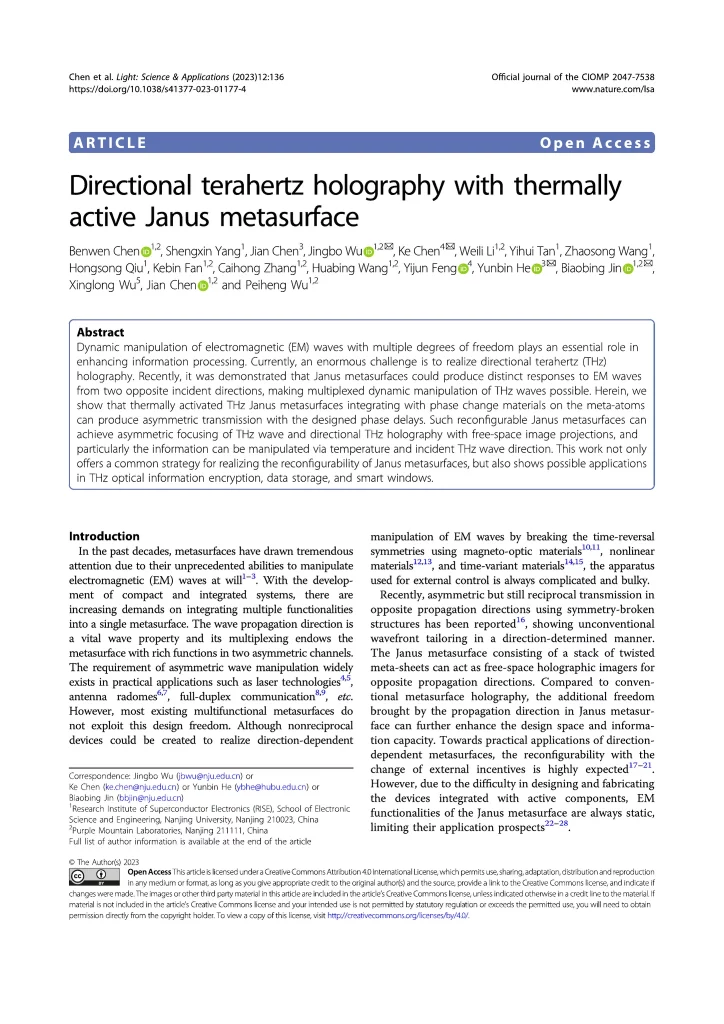
This paper demonstrates thermally reconfigurable terahertz Janus metasurfaces, devices that respond differently to THz waves arriving from opposite directions. By integrating the phase-change material vanadium dioxide (VO2) into the meta-atoms, the authors obtain asymmetric transmission with designed phase delays that switch when VO2 undergoes its insulator–metal transition on heating. Incidence direction and temperature therefore act as independent keys, giving four separate functionalities from a single metasurface. Working around 1 THz, the team demonstrated an asymmetric, varifocal meta-lens and directional holography that projects four independent images. Measurements used a THz spectral imaging system with a wire-grid polarizer to define the incident polarization. Potential applications include THz information encryption, data storage and smart windows.
Key findings
VO2-integrated Janus metasurfaces with direction-dependent, thermally switchable THz response
Four independent functionalities from one device, keyed by incidence direction and temperature
Asymmetric meta-lens and directional four-image holography demonstrated around 1 THz
Potential uses in THz information encryption, data storage and smart windows
Role of the Purewavepolarizers wire-grid polarizer in Janus metasurface holography
A clean input polarization for a device that writes its images in the other one
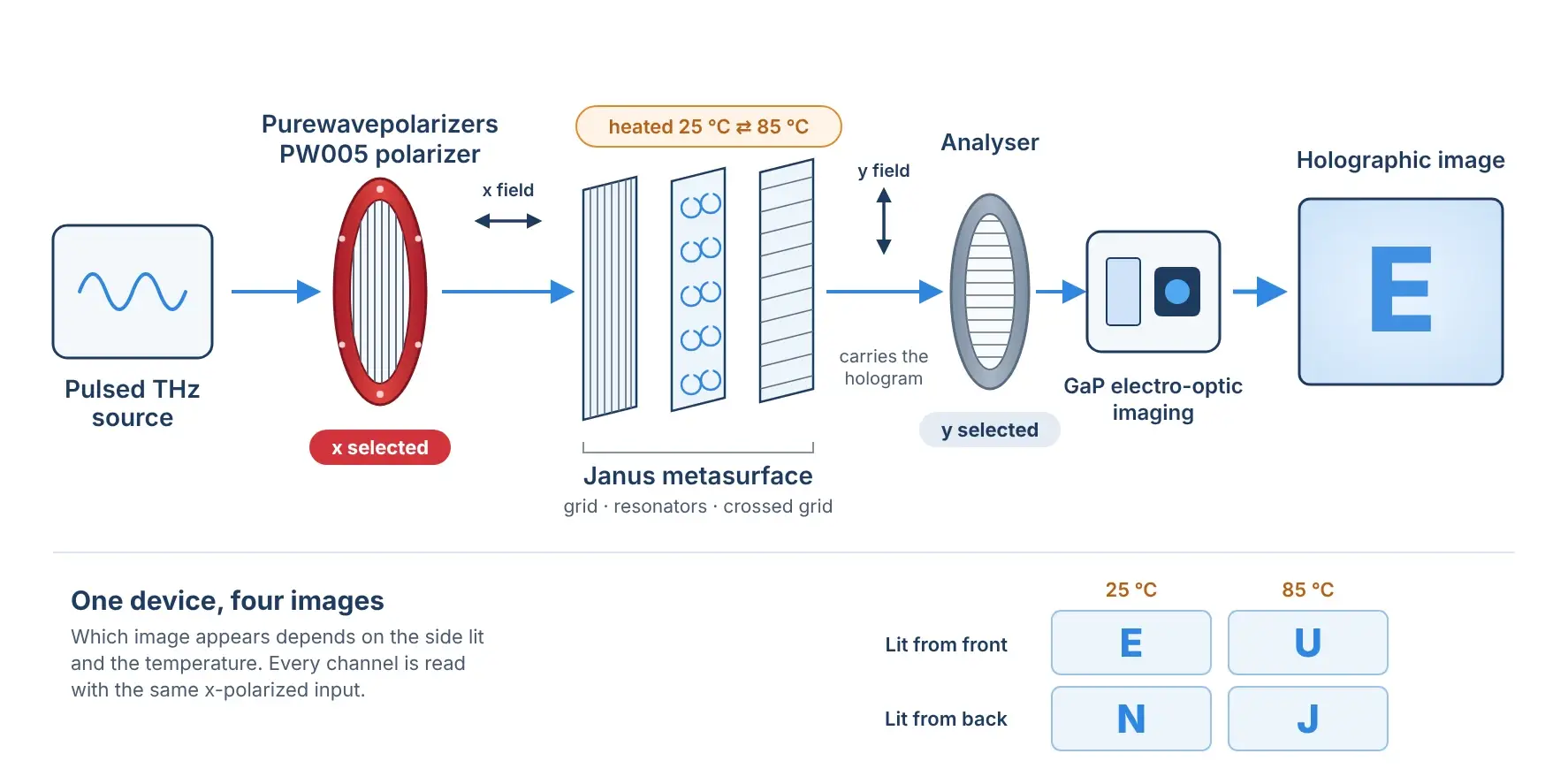
This metasurface holds four terahertz holograms in a single 6 mm chip. Which one appears depends on two things: the side it is lit from, and whether it has been heated. It works by converting polarization. Horizontally polarized (x) light goes in, and the hologram is carried only by the vertically polarized (y) light that comes out. A Purewavepolarizers PW005 polarizer sat directly in front of the chip so that the light going in was x-polarized only.
Note: Illustrative schematic, not to scale; not taken from the paper. Only the input polarizer is explicitly identified as PW005.
Following the polarization through the experiment
1
Purewavepolarizers PW005
In: x only
The wire grid passes only x, so the light reaching the chip has the single polarization the metasurface was designed to accept.
2
Janus metasurface
Inside: x becomes y
Ring resonators between two crossed grids turn x into y. Each one sets a chosen phase, and the pattern of phases forms the image. Heating switches some resonators on or off.
3
Analyser
Out: y only
A second polarizer in front of the GaP detector passes only the converted light, so only the hologram is recorded.
Placed directly in front of the metasurface to set the incoming beam to x
Broadband pulsed THz source; the holograms were imaged by GaP electro-optic detection at about 1.0 THz
Same input polarization for both sides of the chip and both temperatures
4
holograms stored in one metasurface
1.0 THz
operating frequency
>100x
front-versus-back transmission contrast
25 → 85 °C
heating switches the image
Why the polarizer mattered
Comparing four images is only fair if each is made from the same, known input. The metasurface is built to take in one polarization and write its image in the other. Its large front-to-back contrast also depends on getting that input right. With the polarizer just before the chip, every channel saw the same pure x-polarized beam. Any difference between the images then came from the metasurface itself, meaning the side lit and the temperature, and not from stray polarization in the source. Because the grid is free-standing tungsten with no substrate, it adds no substrate absorption or internal reflections to the broadband pulse on its way to the sample.
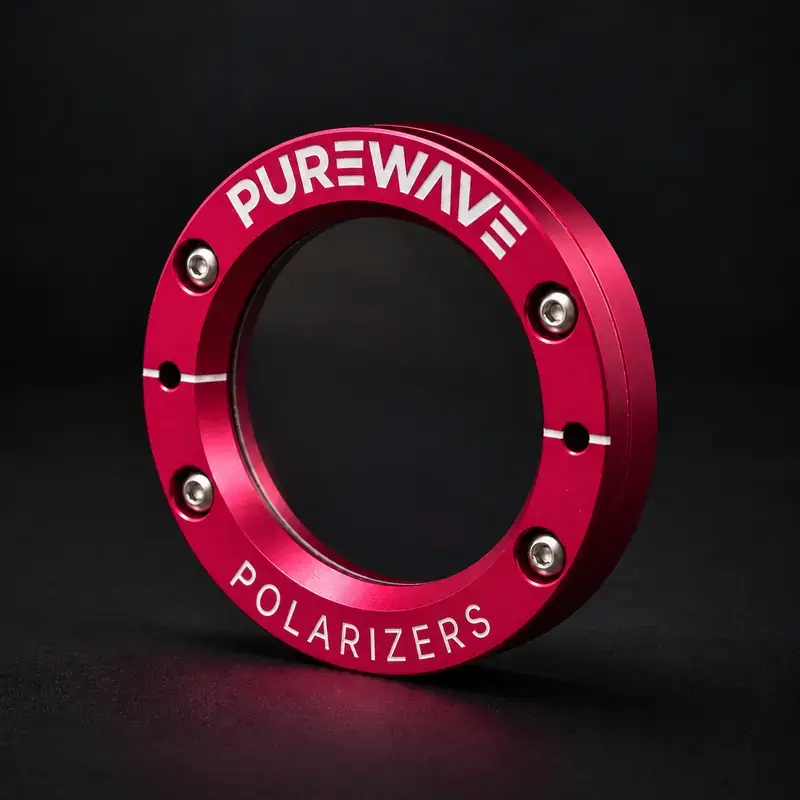
5 µm Tungsten Wire-Grid Polarizer
PW005-series free-standing tungsten wire-grid polarizer (5 µm wire). Placed in front of the metasurface to ensure the incident THz wave was x-polarized.
Frequency stable and low phase noise THz synthesis for precision spectroscopy
A photomixing THz source tunable from 0.1 to 1.4 THz, with Hz-level linewidth and mHz/s stability, resolves 10 kHz-wide hyperfine Lamb dips in water at 556.9 GHz. A polarizing grid separated the double-pass beam in the sub-Doppler setup.
Tunneling motion and splitting in the CH₂OH radical: (Sub-)millimeter wave spectrum analysis
The tunnelling motion of the CH₂OH radical is analysed from new 140–900 GHz spectra and ab initio calculations, determining its ground-state tunnelling splitting. A Purewave wire-grid polarizer enabled a double pass through the 2 m absorption cell.