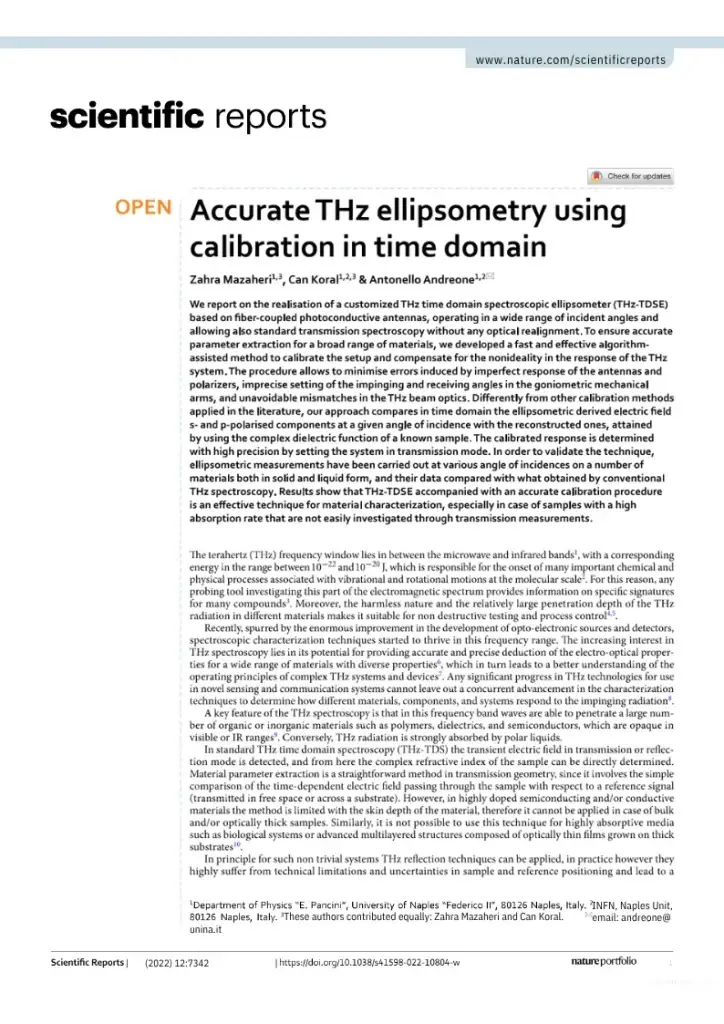
This paper presents a customised terahertz time-domain spectroscopic ellipsometer (THz-TDSE) for accurate material characterisation over a wide range of incidence angles. The fibre-coupled system incorporates three free-standing wire-grid polarizers and an algorithm-assisted time-domain calibration method to compensate for imperfect antenna and polarizer response, imprecise angular positioning and mismatches in the THz beam optics.
Measurements on solid and liquid samples demonstrated good agreement with conventional THz time-domain spectroscopy, showing the potential of calibrated THz ellipsometry for characterising highly absorptive materials that are difficult to investigate in transmission.
Key findings
Variable-angle THz time-domain ellipsometry over approximately 0.1–0.6 THz
Three free-standing wire-grid polarizers used as polarizer, analyzer and compensator
Algorithm-assisted calibration compensates polarization and optical-system non-idealities
Measurements validated on solid and liquid materials against conventional THz spectroscopy
Role of the Purewavepolarizers wire-grid polarizers in THz time-domain ellipsometry
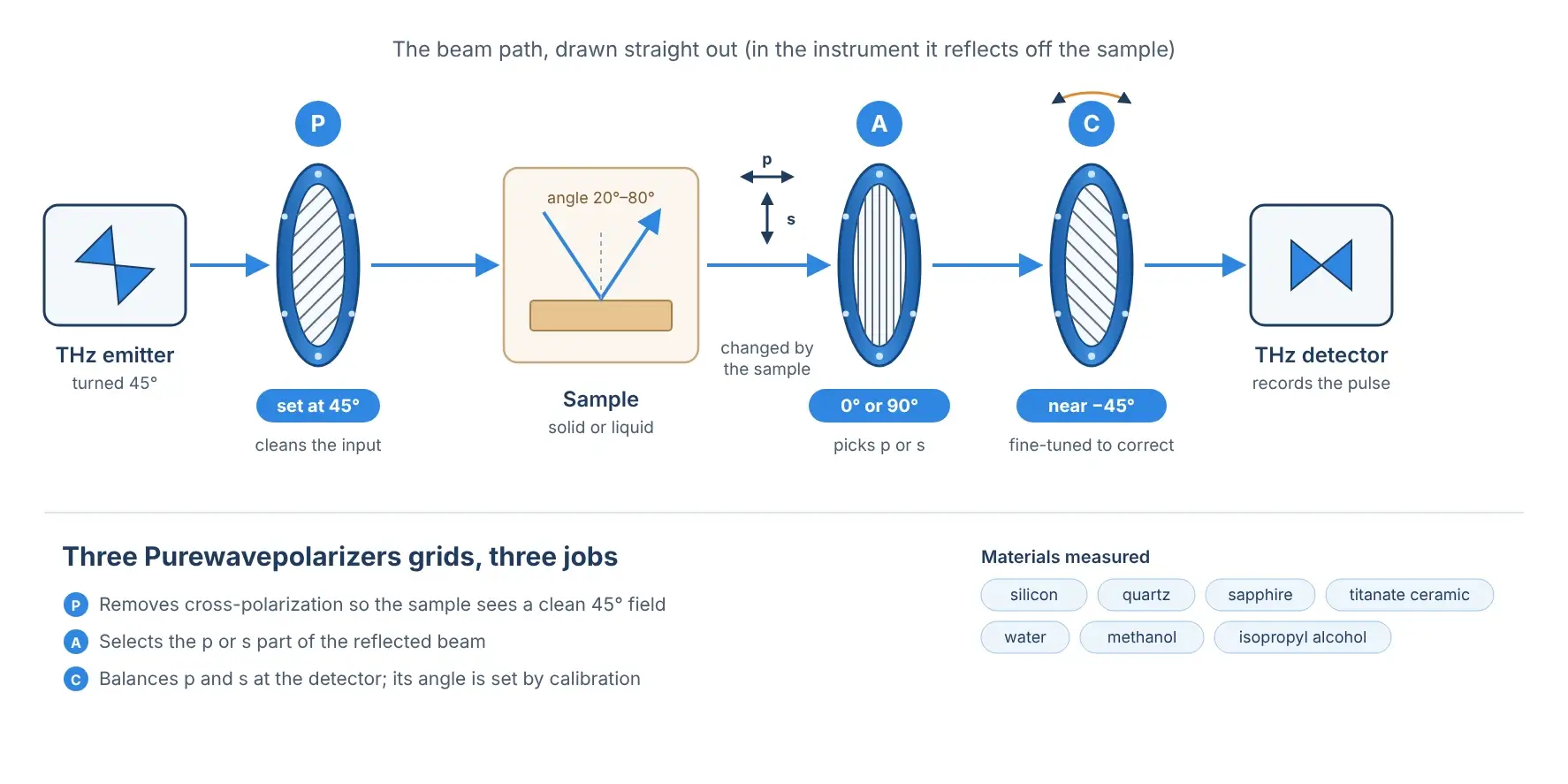
Three grids set, select and balance the polarization in a calibrated ellipsometer
Ellipsometry measures a material by how it changes the polarization of light reflected from its surface. It suits strongly absorbing solids and liquids that are hard to measure in transmission, but it depends on precise polarization control. In this THz ellipsometer, three Purewavepolarizers wire-grid polarizers provide that control. One cleans the beam before the sample, one selects the reflected component to be measured, and a third fine-tunes the balance at the detector, with its angle set by a fast calibration step.
Note: Illustrative schematic, not to scale; not taken from the paper.
Following the polarization through the experiment
1
Purewavepolarizers polarizer (P)
In: clean 45° field
Set at 45° in front of the emitter, it removes cross-polarization so the sample is lit by a clean, known field with both p and s parts.
2
Purewavepolarizers analyser (A)
Out: p or s selected
After reflection, it is turned to 0° or 90° to pass either the p or the s component for measurement.
3
Purewavepolarizers compensator (C)
Balance: tuned near −45°
Just before the detector, it evens out the response to p and s. Its exact angle is found by calibration, correcting small errors elsewhere in the setup.
In the experiment
Three free-standing tungsten wire-grid polarizers from Purewavepolarizers: 10 µm wire, 25 µm spacing, 15 mm aperture
Extinction ratio between 20 and 50 dB
Each grid on a computer-controlled rotation stage
Fiber-coupled THz time-domain system, incidence angles from 20° to 80°, also usable in transmission without realignment
3
Purewavepolarizers grids in one instrument
20–50 dB
extinction ratio
20°–80°
angles of incidence
< 5
calibration steps per angle
Why the grids mattered
An ellipsometer measures only the change in polarization, so any error in the polarizers shows up directly in the result. Here the three Purewavepolarizers grids carry the whole polarization chain: a clean 45° input, a precise choice of p or s, and a compensator that absorbs small imperfections in the antennas, alignment and angles. Because the compensator can be rotated precisely, the authors could calibrate the instrument quickly in the time domain, then measure solids and liquids, including water and alcohols, in good agreement with standard THz spectroscopy. As free-standing grids, they also put no substrate in the beam.
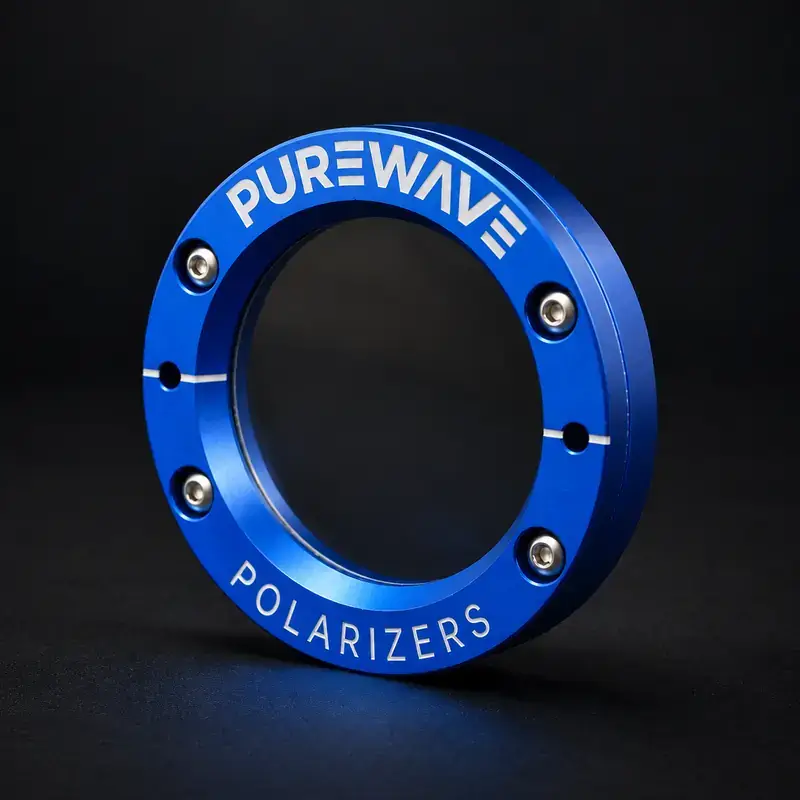
10 µm Tungsten Wire-Grid Polarizer
Free-standing tungsten wire-grid polarizer used for broadband THz polarization control. Three polarizers were employed in the ellipsometer as polarizer, analyzer and compensator.
“For the control and detection of the polarization states we employ three substrate free Wire Grid Polarizers (WGP) from PureWavePolarizers Ltd, with broadband transmission and high extinction ratio ranging between 20 and 50 dB.”
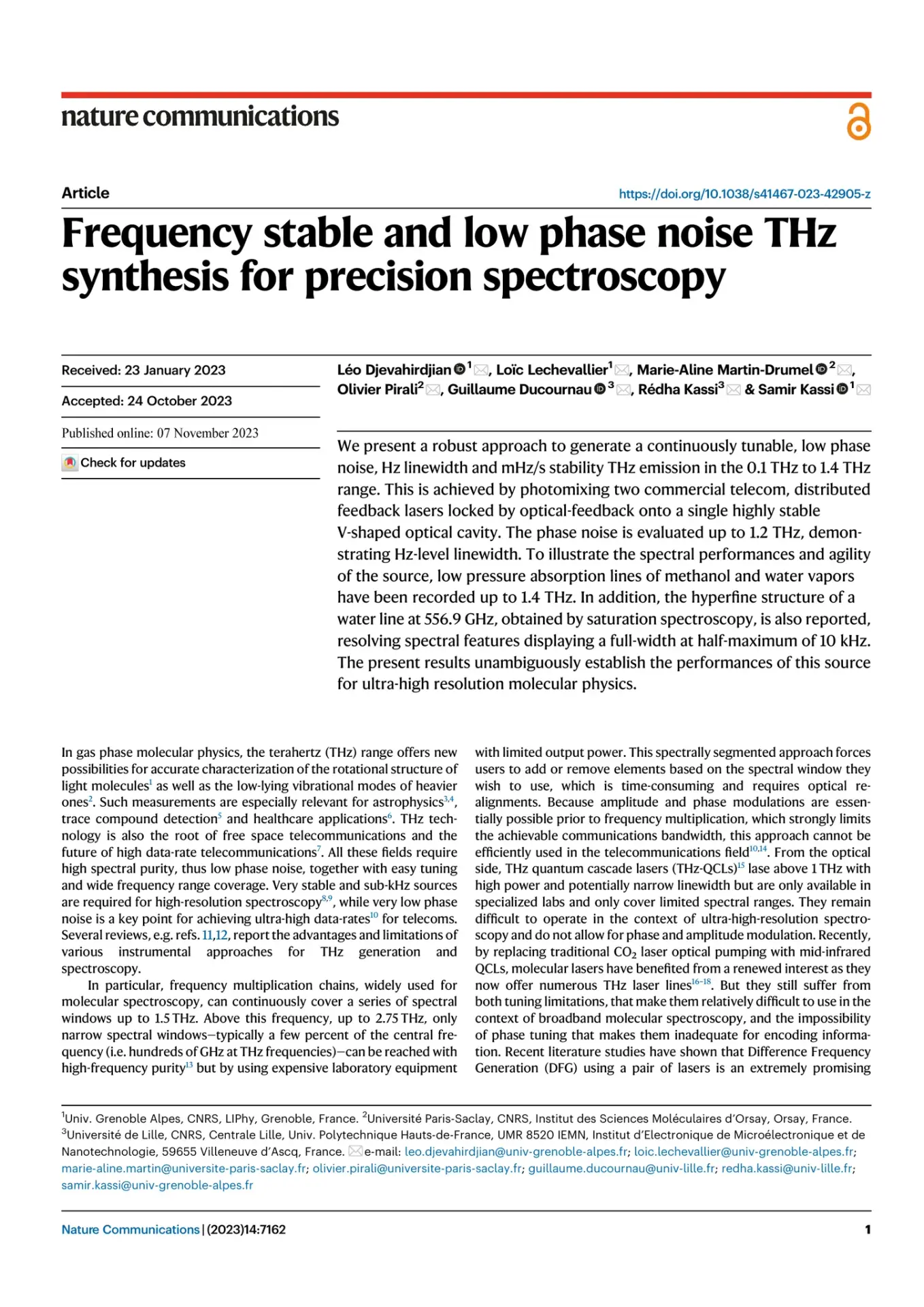
Frequency stable and low phase noise THz synthesis for precision spectroscopy
A photomixing THz source tunable from 0.1 to 1.4 THz, with Hz-level linewidth and mHz/s stability, resolves 10 kHz-wide hyperfine Lamb dips in water at 556.9 GHz. A polarizing grid separated the double-pass beam in the sub-Doppler setup.
Tunneling motion and splitting in the CH₂OH radical: (Sub-)millimeter wave spectrum analysis
The tunnelling motion of the CH₂OH radical is analysed from new 140–900 GHz spectra and ab initio calculations, determining its ground-state tunnelling splitting. A Purewave wire-grid polarizer enabled a double pass through the 2 m absorption cell.