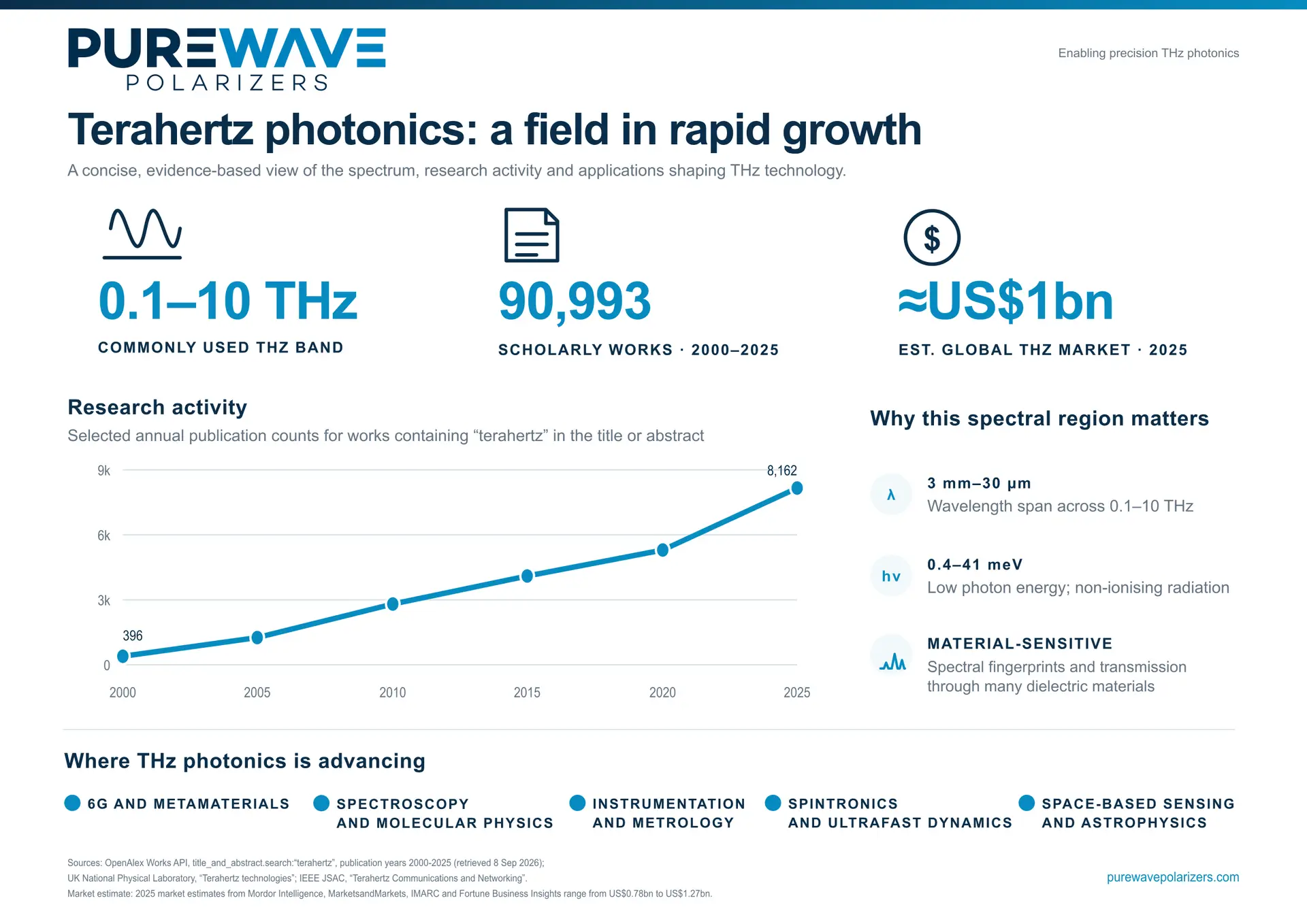
Terahertz photonics concerns the generation, transmission, manipulation and detection of electromagnetic radiation in the region of the spectrum between microwave and infrared frequencies. Commonly associated with frequencies of approximately 0.1–10 THz, this spectral region combines distinctive material interactions with growing capabilities in sources, detectors and optical control. These characteristics support applications across scientific research, communications and precision measurement.
The terahertz region combines long optical wavelengths, low photon energies and material-sensitive interactions that are not readily accessible in neighbouring spectral bands.
Spectral range
Commonly described as approximately 0.1–10 THz, corresponding to wavelengths from around 3 mm to 30 µm.
Low photon energy
Photon energies of approximately 0.4–41 meV; terahertz radiation is non-ionising.
Material-sensitive interaction
Characteristic spectral fingerprints and transmission through many visibly opaque dielectric materials.
THz Photonics for Demanding Applications
Purewavepolarizers components support advanced THz research, spectroscopy, instrumentation and system development across demanding optical applications.
6G and Metamaterials
High-extinction grids enable precise beam-steering and characterization of anisotropic metamaterials for ultra-high-speed communication.
Spectroscopy and Molecular Physics
Resolve complex molecular vibrational modes with high-fidelity, polarization-sensitive analysis for chemical and biological research.
Instrumentation and Metrology
Free-standing grids eliminate substrate dispersion, providing a gold-standard reference for calibrating THz systems with broadband accuracy.
Spintronics and Ultrafast Dynamics
Isolate sub-picosecond magnetic excitations and track ultrafast electron dynamics with paramount polarization purity and speed.
Space-Based Sensing and Astrophysics
Our high-sensitivity grids are essential for mapping faint polarization in the Cosmic Microwave Background and interstellar dust.
Sources and Methodology
The infographic uses published scientific references, publication-index data and current market-research estimates.
View infographic sources and methodology
The commonly used 0.1–10 THz frequency range and corresponding wavelength and photon-energy ranges are based on established descriptions of terahertz technology from scientific and standards literature.
Publication activity was assessed using the OpenAlex Works API, searching for “terahertz” in publication titles or abstracts for the years 2000–2025. The search was retrieved on 8 September 2026.
The approximate 2025 market value is based on published estimates from Mordor Intelligence, MarketsandMarkets, IMARC and Fortune Business Insights. These estimates range from approximately US$0.78 billion to US$1.27 billion.
Published market estimates vary according to the technologies, products and applications included. The value shown in the infographic is therefore presented as an approximate indication of scale rather than a single definitive valuation.
Explore Technical Resources
Continue exploring Purewavepolarizers products, research and technical information.